
How much does a loan officer website cost in 2026?
Loan officer website cost in 2026: DIY builders, mortgage platforms, CRM bundles, freelancers, agencies and done-for-you shops, with sourced prices.
 Ines CallowayDesign lead, Mortgage Website ShopPublished · Updated · 6 min read
KEY TAKEAWAYS
- Published loan officer website prices range from a low monthly fee for a DIY builder to five figures upfront for a custom agency build.
- The cheapest option is rarely the lowest total cost once you count your own hours, compliance fixes and missing lead tools.
- Compare first-year cost, not monthly price: set-up, launch or activation fees change the ranking.
- Ask every provider who writes the content, who places NMLS and licensing details, and who owns the domain.
A loan officer website costs anywhere from $17.77 a month to $15,000 or more upfront, depending on who builds it, who writes it and what it includes. That range is not a typo. It reflects very different products sold under the same name, and the right answer for you depends on how much of the work you want to do yourself.
This guide lays out the published prices we checked on 2026-10-19, turns them into first-year costs, and lists the questions that reveal what each price actually buys. We sell one of the options, so we have tried to be fair and we have linked every source.
lowest published Wix premium plan, billed yearly
Wix, read 2026-10-19
top of the typical custom agency range, upfront
Morty LO website cost guide, read 2026-10-19
active mortgage loan originators in 2025 competing for borrowers
MBA Chart of the Week (NMLS data), 2025-09
What are the main ways to get a loan officer website?
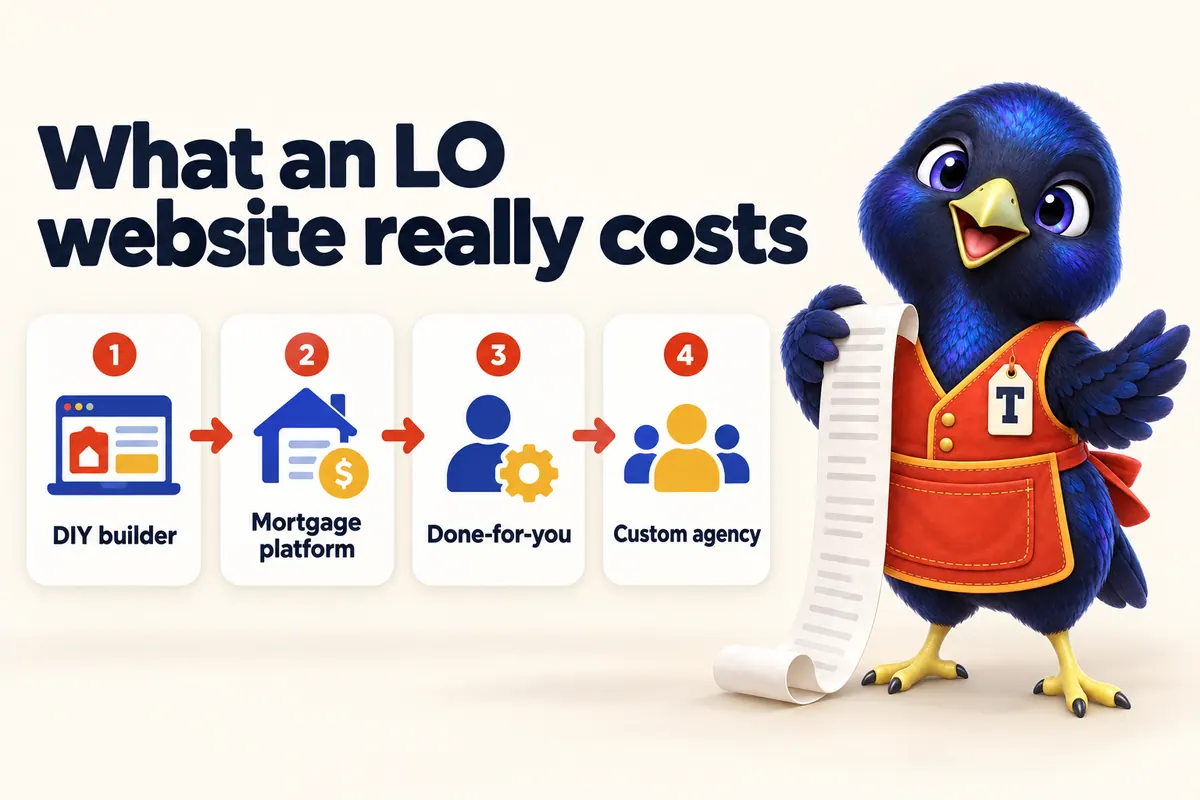
There are six common routes: a DIY website builder, a mortgage website platform, a lending template vendor, a CRM platform that includes a personal site, a freelancer or agency, and a done-for-you shop. They differ less in technology than in who does the work.
- DIY builders such as Wix or Squarespace give you a template and an editor. You design, write and maintain everything.
- Mortgage platforms give you a mortgage-flavoured template with calculators and forms. Writing and configuration vary.
- Template vendors sell lending templates with an activation fee and hosting.
- CRM platforms bundle a personal website with a mortgage CRM and marketing automation.
- Freelancers and agencies build something custom for a one-time fee, often with a maintenance retainer.
- Done-for-you shops start from a finished design and rebrand, rewrite and host it for a monthly plan plus a launch fee.
How much does each option cost?
Published monthly prices start low and climb with the amount of work done for you. The chart below shows the lowest listed monthly price for each provider we could verify, excluding setup or activation fees.
Source: Vendor pricing pages and guides, read 2026-10-19. Setup, activation and launch fees excluded.
Show the data table
| Item | Value |
|---|---|
| Wix | $17.77/mo |
| LendingWise | $29/mo |
| eTrafficers | $49/mo |
| LoanOriginator.net | $50/mo |
| Mortgage Website Shop (Shelf) | $89/mo |
| BNTouch | $165/mo |
Monthly price alone is misleading, though. A $29 plan with a $495 activation fee costs more in year one than its monthly number suggests, and a builder that costs $17.77 a month needs dozens of your hours before it does anything useful.
What is the real first-year cost?
First-year cost is the fairest single number: setup or launch fees plus twelve months of the plan. Here is how the published prices convert.
| Option | Published price | First-year cash cost | Who does the work |
|---|---|---|---|
| DIY builder (Wix, lowest plan) | $17.77/mo billed yearly | $213 | You |
| DIY builder (Wix, highest plan) | $159.77/mo billed yearly | $1,917 | You |
| eTrafficers | $49/mo | $588 | Platform + you |
| LendingWise | $29/mo + $495 | $843 | Template + you |
| LoanOriginator.net | $50/mo + $200 setup | $800 | Platform + you |
| BNTouch | $165/mo + activation | $1,980 + activation | Platform + you |
| Freelancer | $1,000–$5,000+ upfront | $1,000–$5,000+ plus hosting | Freelancer |
| Custom agency | $3,000–$15,000+ upfront | $3,000–$15,000+ plus retainer | Agency |
| Mortgage Website Shop (Shelf) | $89/mo + $449 launch | $1,517 | We do |
| Mortgage Website Shop (Showroom) | $169/mo + $449 launch | $2,477 | We do |
Source: Calculated from published prices read 2026-10-19. Freelancer and agency figures are the low end of Morty's published ranges.
Show the data table
| Label | First-year cost (USD) |
|---|---|
| Wix (low) | 213 |
| eTrafficers | 588 |
| LendingWise | 843 |
| Shelf plan | 1,517 |
| BNTouch* | 1,980 |
| Freelancer | 1,000 |
| Agency | 3,000 |
The asterisk on BNTouch matters: its published Individual plan includes a full mortgage CRM, not only a website, and the activation fee is not published, so the comparison is about scope as much as price.
What are you actually paying for?
You are paying for four things, in different proportions depending on the option: the design, the writing, the technical set-up, and ongoing care. Cheap options shift the writing and set-up onto you. Expensive options include strategy you may not need.
- Writing and program pages: 35%
- Branding and design adaptation: 25%
- Forms, calculators, CRM set-up: 20%
- Compliance placement and review rounds: 12%
- Speed, schema and launch checks: 8%
Source: Illustrative example based on how we scope builds; not a market statistic
Show the data table
| Segment | Share |
|---|---|
| Writing and program pages | 35% |
| Branding and design adaptation | 25% |
| Forms, calculators, CRM set-up | 20% |
| Compliance placement and review rounds | 12% |
| Speed, schema and launch checks | 8% |
Writing is the biggest slice, and it is the one DIY buyers underestimate. A credible loan officer site needs a home page, an about page, six to eight program pages, calculator explanations and FAQs: easily 8,000 to 12,000 words that must be accurate, clear and compliant.
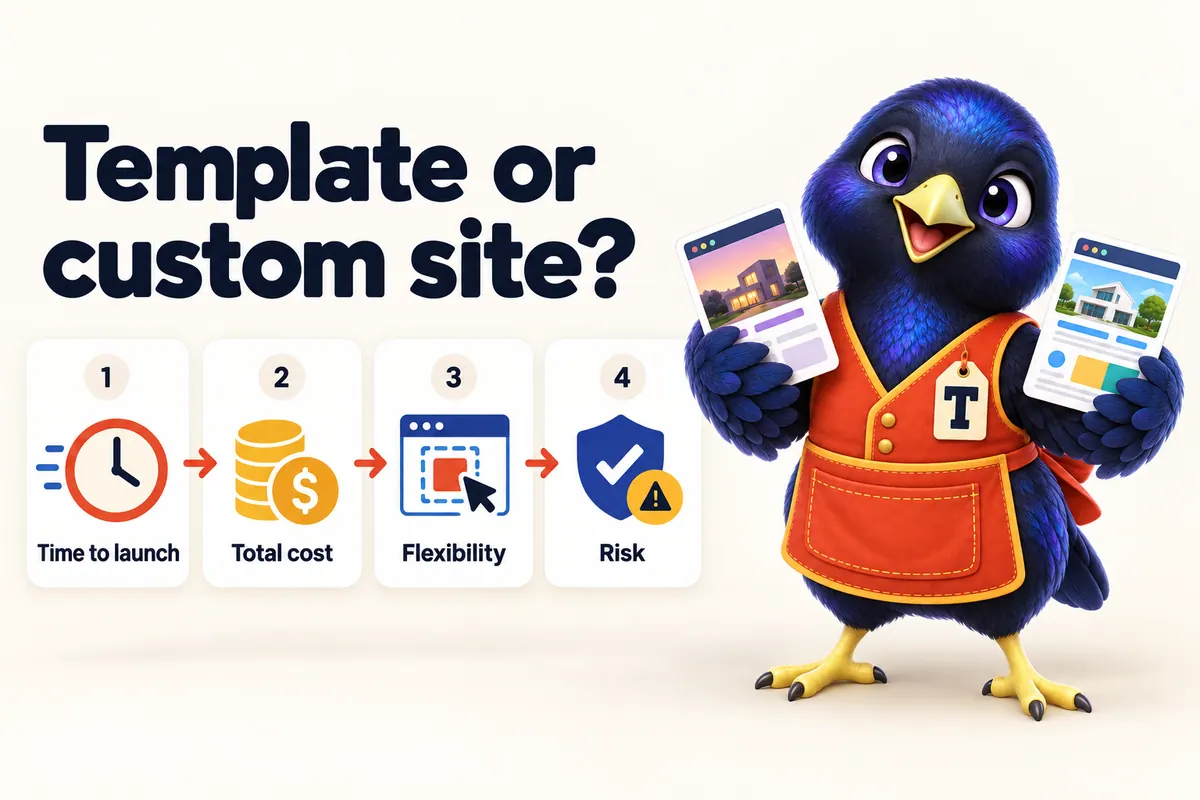
Which option is right for you?
The right option depends on your time, your budget and how much control you want. Here is the honest version.
Three common choices compared
DIY builder
Pros
- Lowest cash cost
- Total control
- Edit any time
Cons
- Your hours to design and write
- Compliance placement is on you
- Mortgage tools via plugins
Best for: Loan officers who enjoy building and have time
Done-for-you shop
Pros
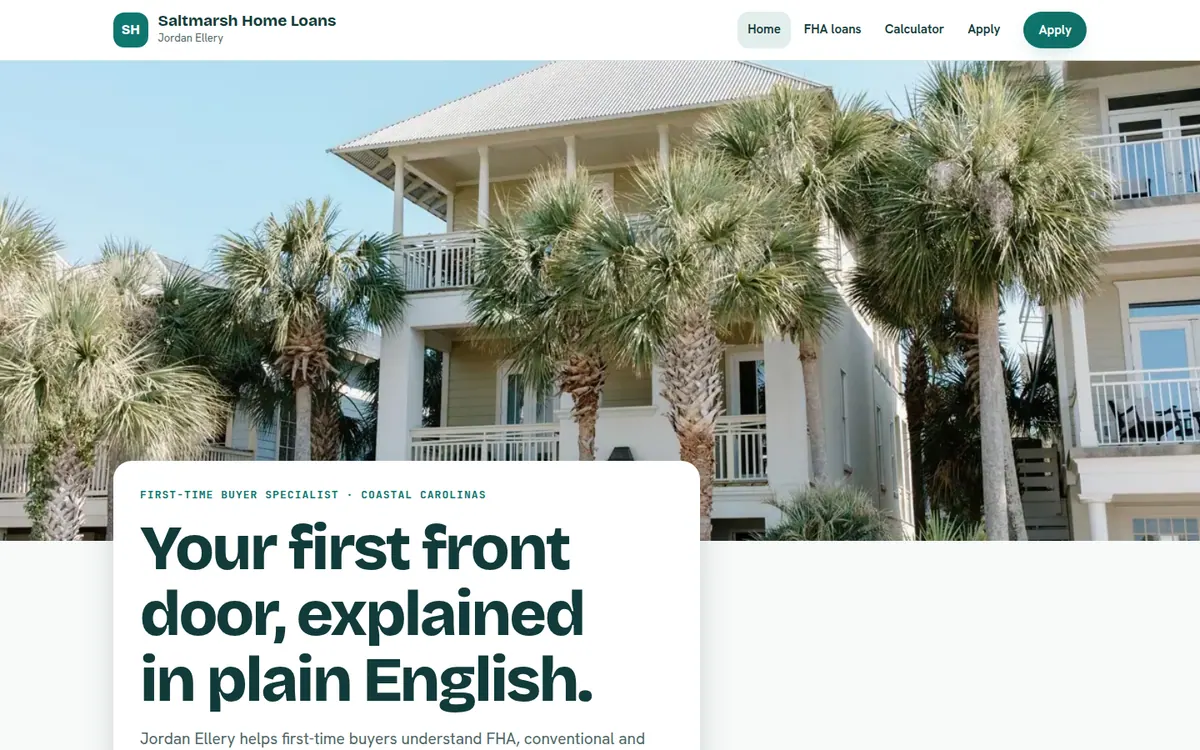
- Finished designs you can see live
- Writing and set-up included
- Launch in about a week
Cons
- Changes stay within the chosen design
- Monthly plan rather than one-off
Best for: LOs who want a professional site fast at a predictable price
Custom agency
Pros
- Fully custom
- Strategy and branding
- Complex integrations
Cons
- Highest upfront cost
- Weeks to months
- Ongoing retainer
Best for: Teams with budget and unusual requirements
What questions reveal the real price?
Ask every provider the same seven questions and the true cost becomes obvious.
- Who writes the pages? If the answer is “you”, budget your hours.
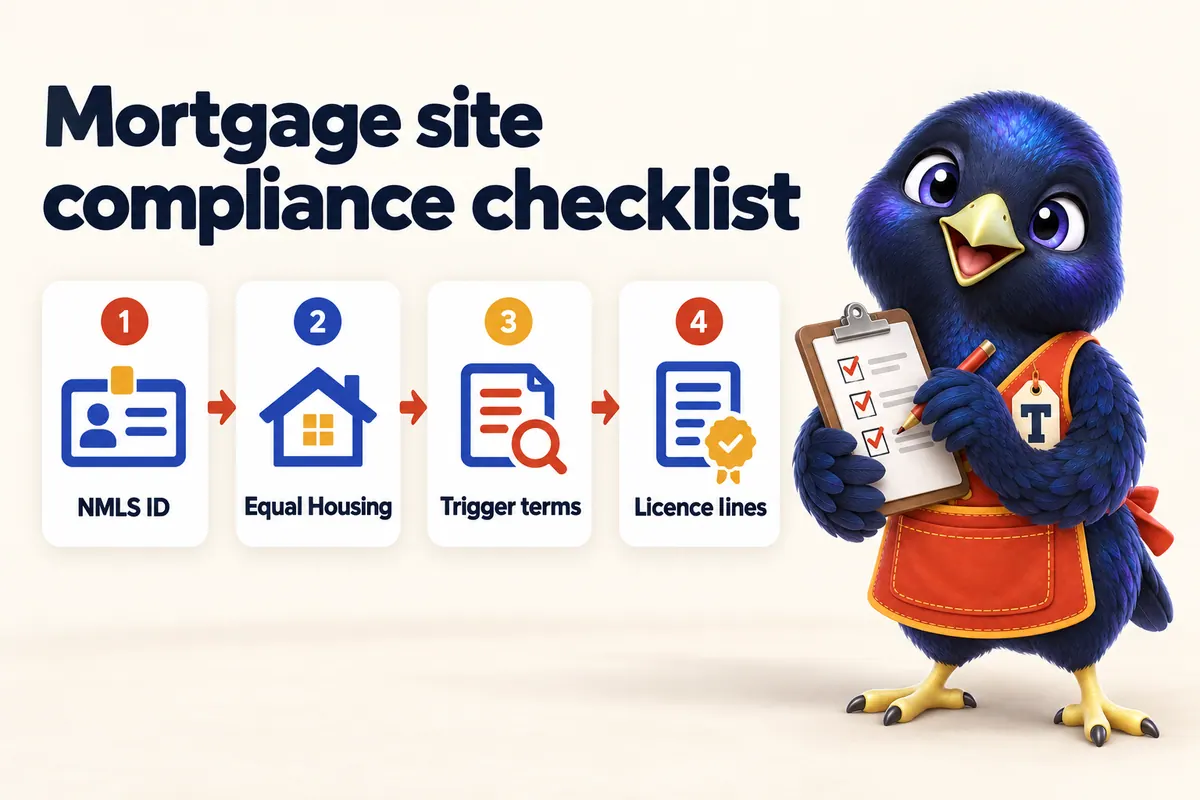
- Who places my NMLS ID, licence lines and Equal Housing statement? Mistakes here cost more than the website.
- Is there a setup, activation or launch fee, and is it refundable?
- Is there a minimum term? Month-to-month changes the risk completely.
- Who owns the domain, content and leads? It should be you.
- How fast are the pages? Ask for a PageSpeed result on a live client site.
- What happens when I cancel? You want an export and help moving your domain.
How much should you budget?
For most individual loan officers, a sensible first-year website budget is the cost of the site plus a small allowance for content and follow-up tools, judged against one or two extra closed loans. With fewer active originators competing (82,500 in 2025, down 34% from 2021 according to the MBA Chart of the Week (NMLS data)), the loan officers who are easiest to find and contact tend to win the conversations that remain.
If you want to test the maths with your own numbers, our ROI calculator shows how many extra loans would cover each plan, and the pricing page lists every price including add-ons and the AI Engine.
What does each price tier actually include?
Price tiers make more sense once you list what is done for you at each level. The same word, “website”, covers very different amounts of work.
At the DIY tier, you get hosting, a template and an editor. You choose the layout, write every page, find or build calculators, place your NMLS and licensing details, connect your domain and keep everything updated. A capable person can produce a good site this way, but it typically takes many evenings, and the mortgage-specific parts are the hardest to get right.
At the platform tier, you get a mortgage-flavoured template with calculators and lead forms already wired. Some platforms include stock program content; others leave writing to you. Designs are often shared across many customers with limited changes, and set-up may still require your time.
At the CRM-bundle tier, the website is one part of a broader system with a mortgage CRM, automation and co-marketing tools. If you already want that system, the website comes along for the ride. If you mainly want a distinctive site, you may be paying for features you will not use.
At the done-for-you tier, someone else rebrands a finished design, writes your pages, places your compliance details, connects your domain and hosts the result. You review and approve. This is the tier where your time cost drops closest to zero.
At the custom tier, a freelancer or agency designs and builds from scratch, often with strategy and brand work. You get maximum flexibility and the longest timeline.
How do you count the cost of your own time?
Your time is the line item most comparisons leave out. A realistic DIY build for a loan officer includes choosing a template, writing a home page and about page, writing six to eight program pages, setting up calculators and forms, adding compliance details, testing on a phone and fixing what breaks. Even for someone comfortable with technology, that adds up to a substantial number of hours, followed by ongoing updates.
A simple way to decide: estimate the hours honestly, multiply by what an hour of your time is worth in loan conversations, and add it to the DIY price. If the total is higher than a done-for-you option, the “cheap” route is the expensive one. If you enjoy building and your evenings are free, DIY can still be the right call; just make that choice knowingly.
What should be included in any mortgage website, whatever it costs?
Whatever you pay, a mortgage website should include a fixed set of essentials. If a quote leaves any of these out, ask why.
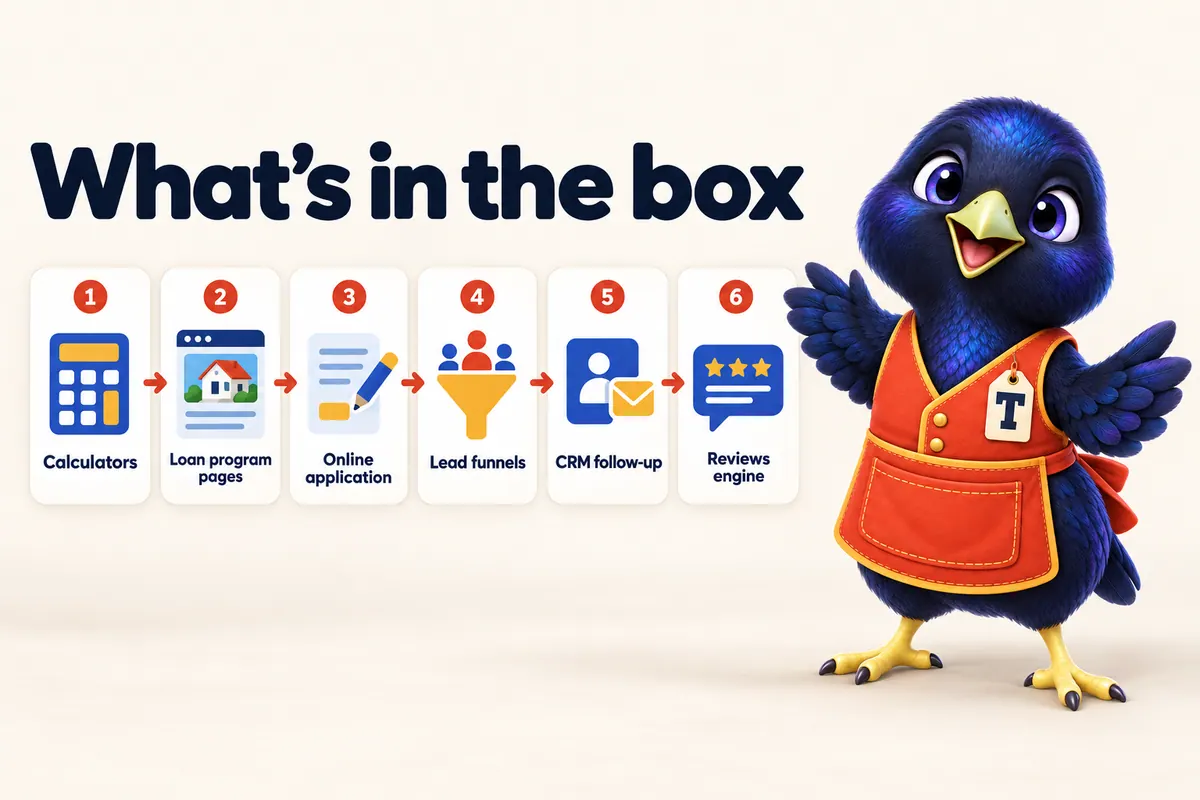
- Program pages for the loan types you actually offer, each answering the questions borrowers search.
- Working calculators: at least a payment calculator, ideally affordability and refinance break-even too.
- A clear path to act: an application link, a short pre-application form or a booking calendar.
- Compliance details: your NMLS ID, company NMLS ID, licensing lines and an Equal Housing Opportunity statement.
- Fast mobile pages: most borrowers will meet you on a phone first.
- Search foundations: unique titles and descriptions, a sitemap, structured data and clean URLs.
- Ownership: your domain, content and leads in your name.
Common pricing traps
A few patterns turn an attractive monthly price into an expensive year.
- Long minimum terms. A low monthly price locked into a long contract can cost more than a higher price you can cancel.
- Per-change fees. If every edit is billed separately, budget for the changes you will inevitably need.
- Activation fees that are not mentioned up front. Always ask for the first-year total in writing.
- Content that is “available” but not written. A template with blank program pages still needs writing.
- Domain held by the provider. Moving later becomes painful if the domain is not registered to you.
- Add-ons for basics. Calculators, SSL or mobile layouts should not be extras in 2026.
The bottom line
The cheapest website is the one that does the most work for the least total cost, including your time. Compare first-year totals, check who writes and configures what, and insist on owning your domain and leads. Then pick the option that lets you spend more of your week with borrowers and less of it with a page builder.
Frequently asked questions
How much does a loan officer website cost?
It ranges from a low monthly fee for a DIY builder you set up yourself, through mortgage platforms priced per month, to several thousand dollars or more upfront for freelancers and agencies, based on published prices and a public cost guide checked in October 2026 (see the first-year table in this article). Done-for-you shops sit in between: a monthly plan plus a one-time launch fee.
Is a low-cost mortgage website platform worth it?
It can be, if it includes what you need: mortgage calculators, program pages, an application path, compliance placement and fast pages. Check what is done for you and what you must write or configure yourself.
Why do some providers charge a setup or launch fee?
The one-time fee pays for the work of branding, writing and configuring your site. Providers without a setup fee often recover that cost through longer contracts or by leaving the writing to you.
What hidden costs should I watch for?
Activation fees, minimum terms, per-page or per-revision charges, paid plugins, domain and email costs, and the hours you spend writing and fixing compliance details.
Should a new loan officer spend more or less on a website?
New loan officers usually benefit from a modest, fast, done-for-you site they can launch quickly and grow later, rather than a large upfront custom build.
Does a more expensive website rank better?
Not automatically. Rankings follow useful content, technical quality, local signals and reputation, not price.
Can my company pay for my website?
Some companies provide or reimburse LO sites. Ask your manager or marketing team; they may also have rules about which providers you can use.
What does a first-year budget usually include?
Set-up or launch fee, twelve months of hosting and maintenance, any add-ons such as funnels or content, a domain, and optionally email and paid tools.
How do I compare quotes fairly?
Convert every quote into a first-year total, list what is done for you versus by you, and check ownership and cancellation terms.
Is it cheaper to build a site myself?
In cash, usually yes. In time, rarely. If your hours are worth more on the phone with borrowers, a done-for-you option often costs less overall.
Sources
- Wix premium plans (read 2026-10-19)
- Morty: LO website costs (read 2026-10-19)
- BNTouch pricing explained (vendor) (read 2026-10-19)
- MBA Chart of the Week: Mortgage Industry Employment (September 2025)
Statistics are quoted with source and date. Mortgage Website Shop is a website and marketing provider, not a lender; this article is general information, not legal or financial advice.