
What every mortgage website must show: a compliance checklist
A mortgage website compliance checklist: NMLS ID display, Equal Housing Opportunity, licensing lines, trigger terms, privacy and accessibility.
 Ines CallowayDesign lead, Mortgage Website ShopPublished · Updated · 6 min read
KEY TAKEAWAYS
- Most mortgage sites need the loan officer's NMLS ID, the company's NMLS ID, state licensing information and an Equal Housing Opportunity statement.
- Advertising specific terms such as a payment or down payment can trigger extra Regulation Z disclosures; the safest default is to explain programs without quoting terms.
- Privacy notices, consent wording on forms and accessibility are part of website compliance too.
- This is general information for marketers. Your compliance officer or attorney approves the final wording.
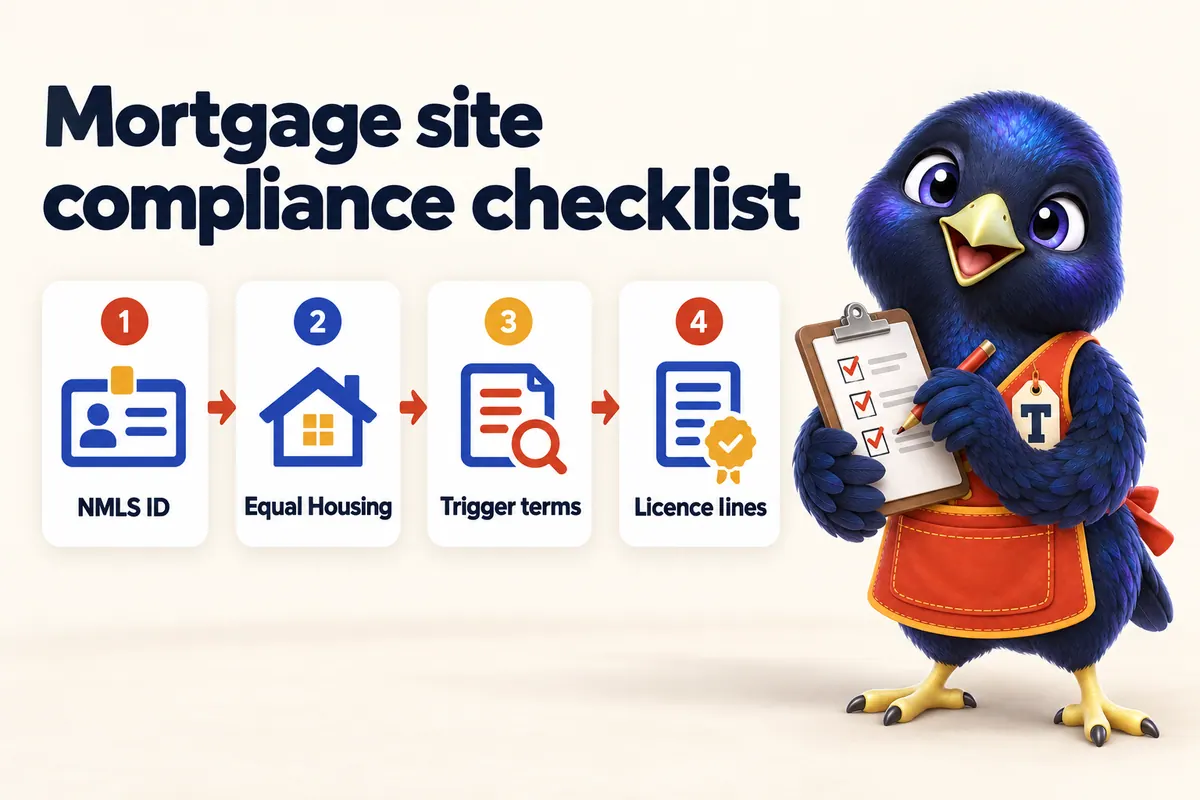
A compliant mortgage website usually shows four things on every page: who you are (with your NMLS ID), who your company is (with its NMLS ID), where you are licensed, and an Equal Housing Opportunity statement. On top of that come privacy, consent and accessibility, plus care with how you advertise loan terms.
This checklist explains each item in plain language for loan officers and marketers. It is general information, not legal advice. Rules depend on your company, your states and the products you advertise, so your compliance officer or attorney has the final word.
active mortgage loan originators in 2025, each with an NMLS identity to display
MBA Chart of the Week (NMLS data), 2025-09
home loan applications reported under HMDA for 2023
FFIEC HMDA 2023 data
core identity items most mortgage sites show on every page
This checklist
Every one of those applications started with a borrower deciding whom to trust, and for many that decision begins on a website.
Source: FFIEC HMDA data as reported by the CFPB (2023 data published 2024)
Show the data table
| Item | Value |
|---|---|
| 2022 | 14.3M |
| 2023 | 10M |
What identification does a mortgage website need?
Most mortgage websites need the loan originator’s name and NMLS ID, the company’s legal name and NMLS ID, and contact information. The SAFE Act and the loan originator rules in Regulation Z (12 CFR 1026.36(g)) require NMLS identification on certain materials, and companies and state regulators commonly expect it on websites.
Practical placement that most compliance teams accept:
- Footer, every page: company legal name, company NMLS ID, and for a personal site, your name and individual NMLS ID.
- Profile or about page: your name and NMLS ID together, near your photo.
- Forms: some companies want the NMLS ID near any form that collects contact details.
- A link to NMLS Consumer Access so borrowers can verify the licence themselves.
Fewer originators are competing for business than a few years ago, which makes it more important that the ones who remain are easy to verify.
Source: MBA Chart of the Week (NMLS data), 2025-09
Show the data table
| Label | Active MLOs |
|---|---|
| 2021 | 125,000 |
| 2025 | 82,500 |
What licensing information should appear?
State licensing information tells borrowers where you are allowed to originate loans. Many states expect specific licensing language for mortgage lenders, brokers or originators, and some require the licence number or the name of the licensing agency.
A simple approach is a “Licensing” line or page that lists each state with the licence type and number in the exact words your compliance team provides, linked from the footer. When you add or drop a state, update it everywhere at once. That is easiest when the details live in one data file that every page reads.
Does a mortgage website need the Equal Housing Opportunity logo?
Fair-lending advertising guidance expects mortgage advertising to carry an Equal Housing Opportunity statement or logo. On websites, the most common practice is the statement in the footer of every page, and the official logo where the company supplies an approved asset.
Two cautions: never redraw or approximate the logo (use the official file your company provides), and make sure images and copy across the site do not suggest a preference for or against any group of borrowers.
What are trigger terms, and why do they matter?
Trigger terms are specific credit terms that, if stated in an advertisement, require additional disclosures under Regulation Z. For closed-end credit, they include the amount or percentage of any down payment, the number of payments or period of repayment, the amount of any payment, and the amount of any finance charge.
If a page says “only $1,500 a month” or “3% down”, it may need to state other terms too, such as the APR and repayment terms. Many loan officer sites avoid this by explaining how programs work instead of advertising specific terms, and by labelling calculators as educational estimates.
| Phrasing | Likely status | Why |
|---|---|---|
| "FHA loans can allow a lower down payment" | Generally not a trigger term | No specific amount or percentage stated |
| "3.5% down FHA loans" | Trigger term | States a down payment percentage |
| "Payments from $1,450 a month" | Trigger term | States a payment amount |
| "30-year fixed options available" | Check with compliance | Repayment period may be a trigger term |
| "Use our calculator to estimate a payment" | Generally not a trigger term | No terms advertised; tool labelled as an estimate |
What privacy and consent elements are needed?
A mortgage website needs a privacy policy, a cookie notice that actually controls non-essential scripts, and clear consent wording on any form whose submitters you will call or text.
- Privacy policy: what you collect, why, who receives it, how long you keep it, and how people use their rights under state privacy laws.
- Cookie consent: analytics and marketing tags should not run before consent.
- Form consent: if you will text or call with automated tools, capture prior express consent under the TCPA with wording approved by compliance.
- No sensitive identifiers on public forms: collect Social Security numbers only in a secure application system.
Do mortgage websites have to be accessible?
Accessibility is increasingly treated as a legal expectation for business websites under the ADA, and it is a fairness issue for borrowers. The practical standard is WCAG 2.2 at level AA: readable contrast, keyboard navigation, alt text, captions, forms with labels, and no content that relies on colour alone.
The mortgage website compliance checklist
Use this as a review list with your compliance team before launch and after big changes.
| Item | Where it usually goes | Done? |
|---|---|---|
| Your name and individual NMLS ID | Footer and profile page | ☐ |
| Company legal name and NMLS ID | Footer, every page | ☐ |
| State licensing lines | Footer link or licensing page | ☐ |
| Equal Housing Opportunity statement (official logo if approved) | Footer, every page | ☐ |
| No unapproved trigger terms in copy or images | Site-wide | ☐ |
| Calculator disclaimers and example-rate sources | Each calculator | ☐ |
| Privacy policy and cookie notice | Footer and banner | ☐ |
| Consent wording on forms | Every form | ☐ |
| Accessibility statement | Footer | ☐ |
| Co-marketing pages reviewed for RESPA | Any partner page | ☐ |
Two ways to handle compliance on a website
Add it later
Pros
- Faster first draft
Cons
- Easy to miss pages
- Inconsistent wording
- Changes are manual everywhere
Best for: Nobody, really
Build it into the design
Pros
- One approved block on every page
- Updates once, applies everywhere
- Easier compliance review
Cons
- Needs details up front
Best for: Every loan officer and branch
How should compliance details be designed into a site?
Compliance elements work best when they are designed in from the start rather than pasted in at the end. That means deciding where each element lives, writing it once, and making sure every page uses the same approved version.
A practical layout that compliance teams tend to approve quickly:
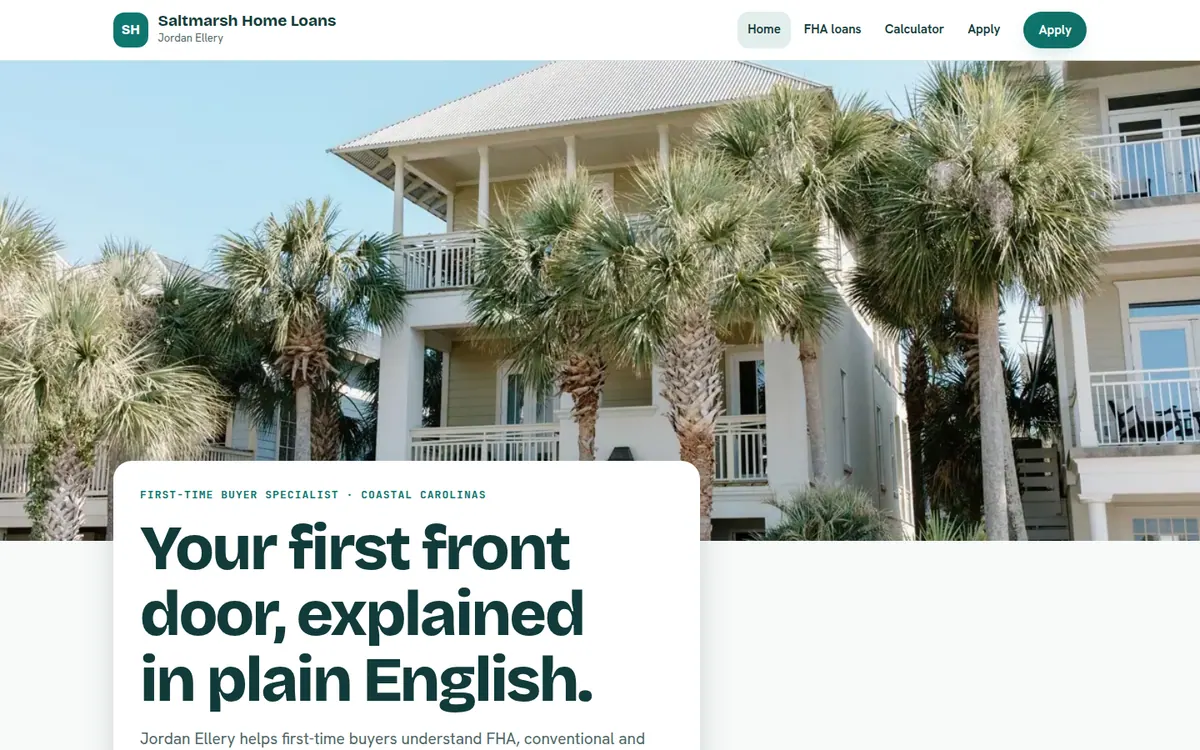
- A footer compliance block on every page with the company legal name, company NMLS ID, your name and NMLS ID (on personal sites), an Equal Housing Opportunity statement, links to privacy, terms, accessibility and licensing, and a short “not a commitment to lend” disclaimer if your company requires one.
- A licensing page listing each state, licence type and number in your compliance team’s exact wording.
- A profile block next to your photo with your name, title, NMLS ID and a link to NMLS Consumer Access.
- Form notes under each form: what happens to the information, a link to the privacy policy and consent wording where you will call or text.
- Calculator notes under each calculator: estimates only, not an offer, and the source and date of any example rate.
The design benefit is consistency. When the compliance block lives in one component fed by one data file, a licence change updates every page at once, and the compliance review only has to approve the block once.
What do compliance teams usually ask to change?
Compliance reviews of mortgage websites tend to focus on the same handful of issues. Expect questions about these, and you will save a revision round.
- Absolute language. Words like “guaranteed”, “always” or “lowest” in relation to rates, approvals or timelines.
- Implied terms. Phrases like “no money down” or “low payments” without the required context.
- Program accuracy. Outdated loan limits, mortgage insurance details or eligibility statements.
- Testimonials. Whether reviews are genuine, attributed, and free from statements about terms.
- Images. Whether photography could suggest a preference for any group of borrowers.
- Co-marketing. Shared pages with real estate agents and how costs are split.
- Social and AI channels. What automated replies say and whether they disclose that they are automated.
How often should a mortgage website be reviewed?
Review the site at launch, whenever you add or drop a state or product, before you start an advertising campaign that links to it, and on a regular schedule your company sets (many choose quarterly or annually). Keep a simple log of what changed and who approved it. If a regulator or your company ever asks, a dated record of approvals is far easier than reconstructing history.
What about AI chat and automated replies?
Automated replies are marketing communications too. Any AI chat, text or DM assistant on your site should use approved answers, disclose that it is automated, avoid quoting rates or terms, and hand off to a licensed person for anything specific. Texting adds TCPA consent and carrier registration requirements. Treat the configuration of these tools as part of your website compliance review, not a separate afterthought.
A note on accessibility and fair lending
Accessibility and fair lending overlap more than people expect. A site that cannot be used with a screen reader, or that relies on colour alone to explain a form error, excludes some borrowers from information and from applying. Building to WCAG 2.2 AA, writing in plain language, offering a Spanish version where your market needs it, and treating every visitor to the same path to a licensed loan officer all support the spirit of fair-lending rules as well as the letter of accessibility expectations.
How do you keep a site compliant over time?
Compliance is not a launch task. Licences change, companies change, programs change. Keep your NMLS and licensing details in one place, review the site whenever you add a state or product, and re-check pages before running ads. Our compliance block is designed for exactly that, and the online application keeps sensitive data off public forms.
Frequently asked questions
Does my mortgage website need my NMLS ID?
In most cases, yes. The SAFE Act and Regulation Z's loan originator rules require NMLS identification on certain materials, and companies and state regulators commonly expect the individual and company NMLS IDs on websites. Your compliance team confirms where.
Where should the NMLS ID appear?
Commonly in the footer of every page and on the loan officer's profile or about page, next to the name. Some companies also require it near contact forms.
Do I need the Equal Housing Opportunity logo or just text?
Fair-lending advertising guidance expects an Equal Housing Opportunity statement or the official logo on mortgage advertising. Many sites show both; use only the official logo asset your company approves.
What are trigger terms in mortgage advertising?
Under Regulation Z, stating certain specific credit terms in an ad, such as a payment amount, the number of payments, the period of repayment, a down payment amount or percentage, or a finance charge, triggers additional required disclosures.
Can I show interest rates on my website?
You can, but advertising a rate brings extra requirements (for example disclosing the APR) and the rate must be accurate and current. Many loan officers avoid publishing rates on their sites for that reason.
Does my site need a privacy policy?
Yes. A privacy policy is expected by state privacy laws such as California's, by platforms you advertise on, and by borrowers. It should describe what you collect, why, and who you share it with.
Do mortgage websites have to be accessible?
Courts and regulators increasingly treat business websites as covered by the ADA. Building to WCAG 2.2 AA and publishing an accessibility statement is the practical standard.
What about co-marketing pages with real estate agents?
RESPA Section 8 restricts referral fees and things of value between settlement service providers. Co-marketing pages and shared costs should be reviewed by your compliance team before launch.
Do I need consent language on my forms?
If you will call or text people who submit a form, especially with automated tools, you should capture consent with clear wording under the TCPA. Your compliance team approves the exact text.
Who is responsible if my website is non-compliant?
Generally the licensed professional and their company. Website providers can build compliance elements in, but approval and responsibility sit with you and your compliance team.
Sources
- CFPB: Regulation Z (12 CFR 1026) (read 2026-10-19)
- NMLS Consumer Access (read 2026-10-19)
- HUD: Fair Housing and Equal Opportunity (read 2026-10-19)
- FFIEC / CFPB: 2023 HMDA data on mortgage lending (2024)
- MBA Chart of the Week: Mortgage Industry Employment (September 2025)
Statistics are quoted with source and date. Mortgage Website Shop is a website and marketing provider, not a lender; this article is general information, not legal or financial advice.